AI agents · Claude · agent architecture
What I learned trying to over-organize my agents, and what Anthropic's Applied AI team taught me
I gave my company's agent 23 subagents in five departments. Anthropic's newest guidance explained why that was the wrong shape, and testing it on my own system showed me something worse.

Robert MillOctober 30, 2026 · 5 min read
I have been building teams of agents for my work. Lately I have been trying to get them to learn from what they do.
Somewhere along the way I ran into a wall. Should this be a team of subagents, organized like a regular company, or one super-agent with all the skills it needs?
I had already answered it without noticing. Our agent had 23 named subagents in five departments: sourcing, market research, competitive intelligence, writing and model tiers. Each one had a face, a title and a model. It looked great. It looked exactly like an org chart.
So I went searching, and found an article from Anthropic's Applied AI team, published on October 22: .
What the article says
Written plainly in it: across several enterprise deployments, a single agent with skills often beat both the one-giant-prompt design and the subagent design on quality, and often on cost and speed as well.
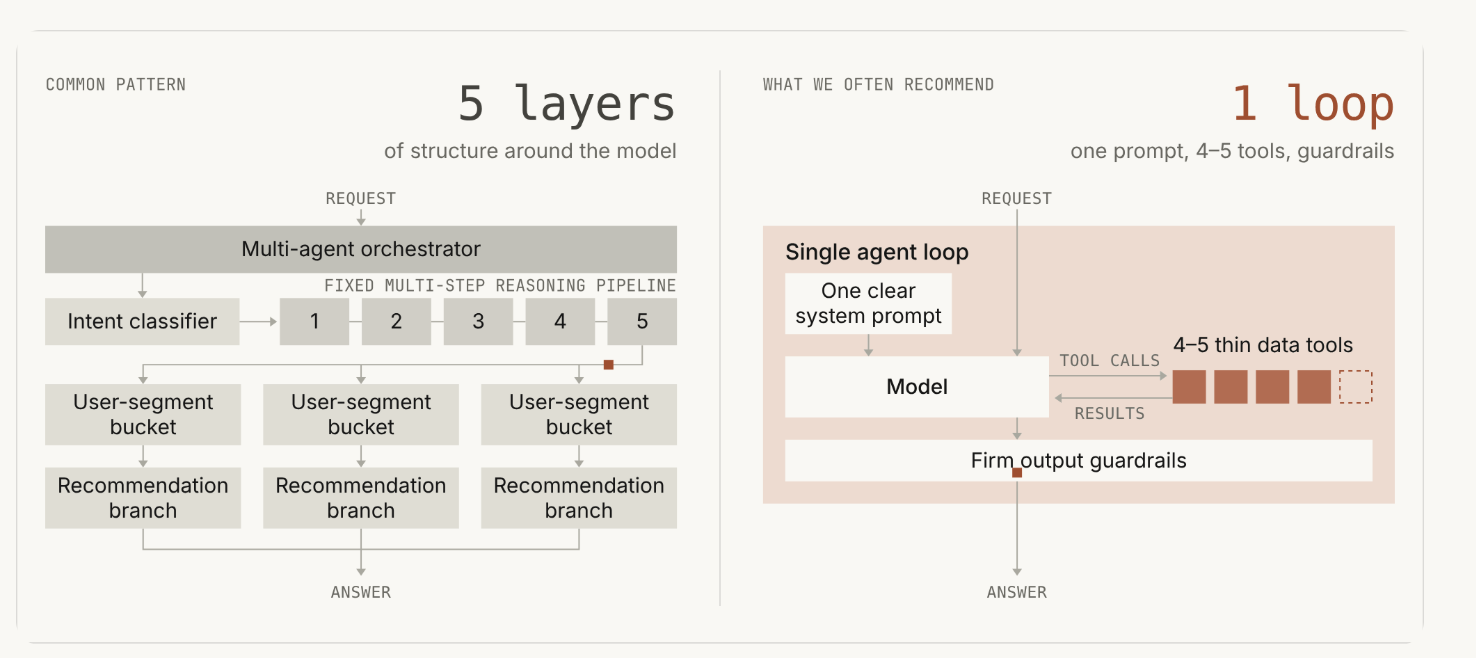
Source: Anthropic, "Building agents: When to fold subagents into your main agent loop."
Then they name the trap. Companies give each team or problem its own subagent, and the agent architecture becomes "a copy of their org chart." Conway's law, applied to AI.

That was my setup, almost exactly.
Why the org chart stops working
The analogy that made it click for me is the human one. When you delegate a task to eight different people, you rarely get what you would get by doing the whole thing yourself. We delegate because one person cannot hold everything, not because splitting the work makes it better. Every handoff loses something. A subagent starts with a blank context, gets a short brief, and hands back a summary. Everything else stays behind.
The second reason is that the structure we built a few months ago was built for weaker models. Routers, fixed planning steps, check steps. Newer models plan, track their progress and check their own work. The orchestration has moved into the model weights, and the extra structure now slows down the intelligence it was supposed to help.
One line I want to be careful with: what moves into the model is judgment. Hard limits stay in code. Our agent still cannot send an email without my click, and that is not changing.
There is a bigger version of this I keep thinking about. Jack Dorsey and Roelof Botha argued this spring that companies use hierarchy mainly to move information around, and that AI can now do that job. Anthropic is making the same point about agents. Both kinds of org chart exist because no single person could hold the whole picture. We have never worked alongside an intelligence that can.
When a subagent still earns its place
The article does not say delete them all. Subagents still belong on compact, siloed work that comes back with a clear answer: research that reads far more than the main agent needs, jobs that run in parallel with fresh context, or a context that is genuinely overloaded. My shorthand: delegate the reading, keep the thinking. In our system that means the agents that map a company's org chart, research competitors and run the morning market sweep stay.
A full handoff, where the subagent takes over the conversation, is only for when it needs to talk to the user directly. We already do a version of this. The assistants that greet you on different pages of our internal tool look separate, but they are one agent wearing a different persona per page. Many faces, one brain.

Where the rest go
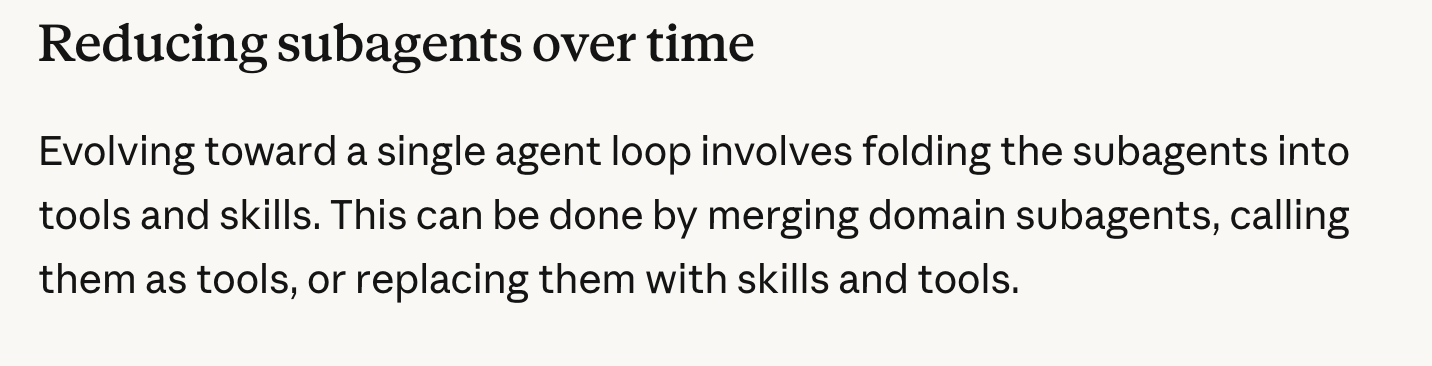
Slowly, into skills and tools. Skills hold how the team works: the steps, the rules, the judgment calls. Tools hold actions and live data. You fold one subagent at a time and score the system before and after.
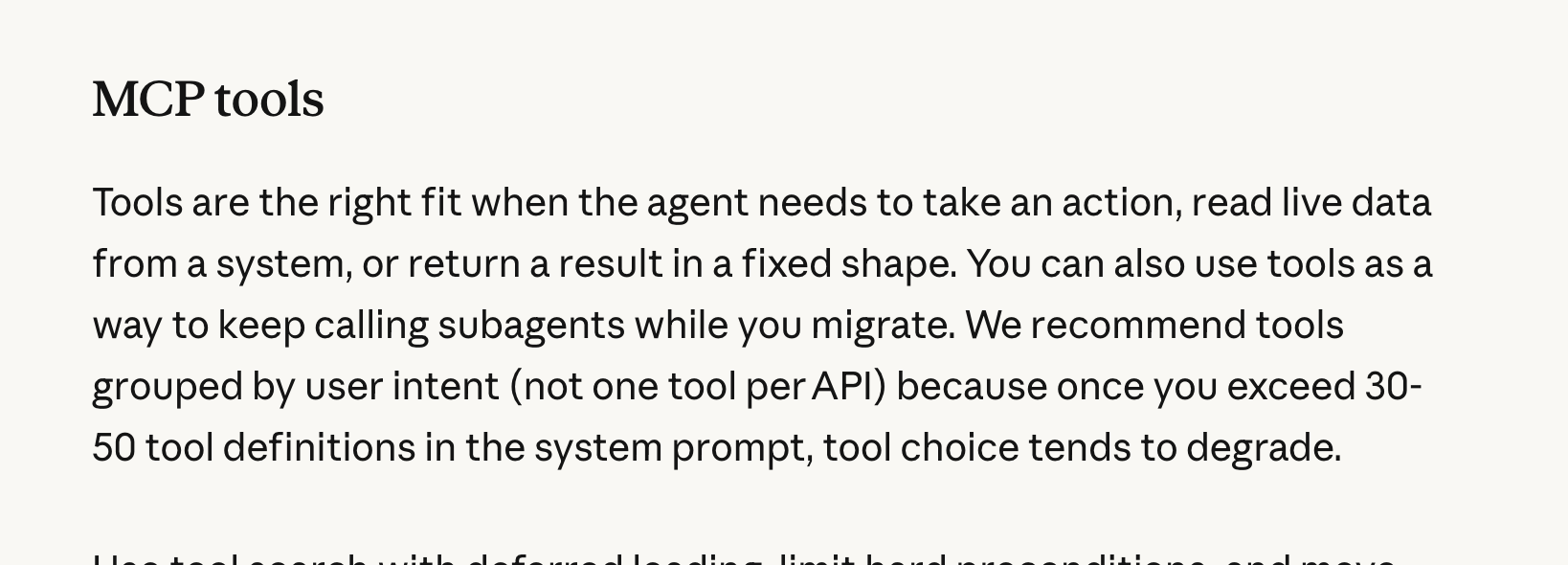
The article also says to group tools by intent rather than having one per API call, because past 30 to 50 tool definitions, tool choice starts to degrade. Our agent keeps 59 loaded at all times because those cover 93% of its calls. I am over the line, and now at least I know why.
What happened when I tested it on my own system
I audited the team first. Against the article's rules, 23 agents become about 10.
Then I checked how often our agent actually opens its skills, since that is where the article says the know-how should go. Outside one busy fortnight, about once in every fifty conversations. The place I was about to move everything into was a place my agent rarely looked.
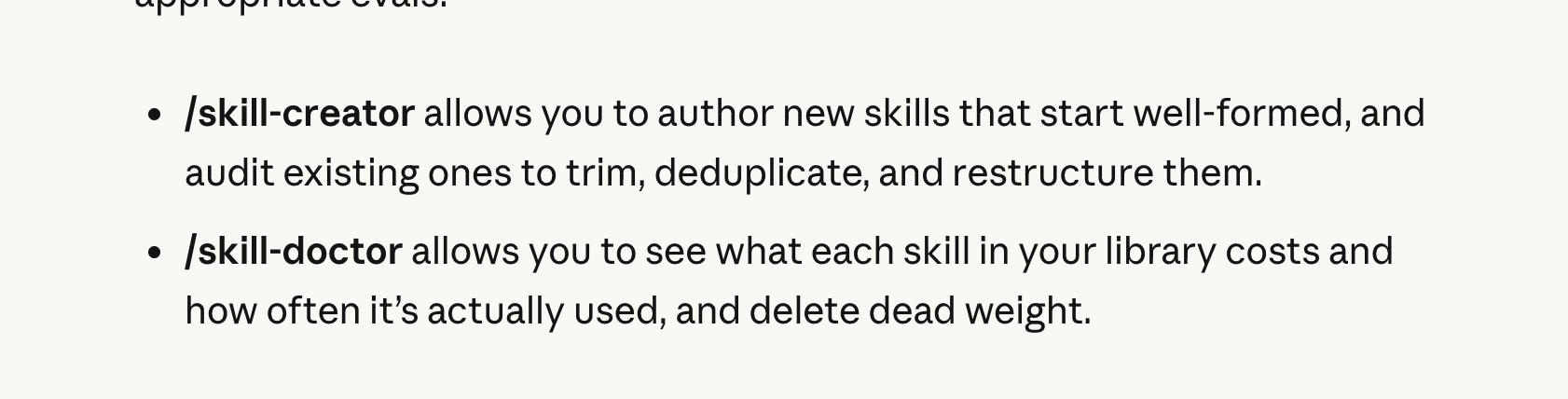
Anthropic's tools for auditing skills. Trying them is what sent me to measure my own.
So I ran Anthropic's prompt audit on our agent's instructions. It found 33 issues. One of the main rules told the agent that "load" meant extra tools, and that rule outranked the list of skills. Five prompts described my own company differently from the rest. We fixed and shipped the clear ones the same day.
Where I have landed
The line that stuck with me from the article: it is better when the model that writes the plan also carries it out.
Next I fold the first subagent, the LinkedIn drafter, into the skill that already does its job, score it before and after, and keep the change only if it holds.
The question was never how many agents. It is where the thinking should live.